A smooth circle in Math D
No pi, no cosine, no zero. A point is stepped round the way a weight on a spring swings, counted step by step, and the path closes on itself as a smooth round. Then it is measured, never assumed: the old world’s pi comes out of the counting.
Try it: a circle of your own
Give a radius in your own numbers. Delta makes it on the server (circle.d, a Delta program run as a page)
and answers in your numbers; your browser only draws what Delta sends back.
fe3355b3-6294-4607-9204-341637557dc9, Mike J HebblethwaiteThe film starts right down at the first steps, each a straight piece, and zooms out a little each picture as the stepping speeds up. Up close the path is straight pieces; zoomed out it reads as a smooth round, as a real edge does in nature (Mike: “we go tiny atomic level and zoom to x width to show it like nature is”). The step count is drawn in the D Angle numerals: each digit a hex spiral.
Seen as it is
Zooming out makes the steps look as if they grow and then shrink away (Mike: “it looks like the steps grow then retract at this angle”). They do not: every step is the same size. So here is another angle, with nothing zooming: the whole round at one size drawing itself round, and a lens of one fixed magnification riding with the newest step. In the lens every step is the same length, as it really is; only its way turns as the point goes round.
572ec809-d0bd-4452-a363-dc3f6a406c12, Mike J HebblethwaiteThe rule, in D
Each step, two moves, one after the other (K is how fine the steps are: here 4723, each step a
ten-thousandth of the way across):
x  ->  x less (y / K)
y  ->  y with (x / K)      (the new x)
Places either side of the middle are kept above a level, so nothing is ever minus or nothing: a place on the middle line is the level itself, never a count of nothing. The length walked is added up step by step, each step’s length by a whole square root of its two moves squared.
What came out
- One whole turn:
227A7steps (62,836 in the old numbers). - The walk round over the distance across:
ACCB4hundred-thousandths (3.14149).
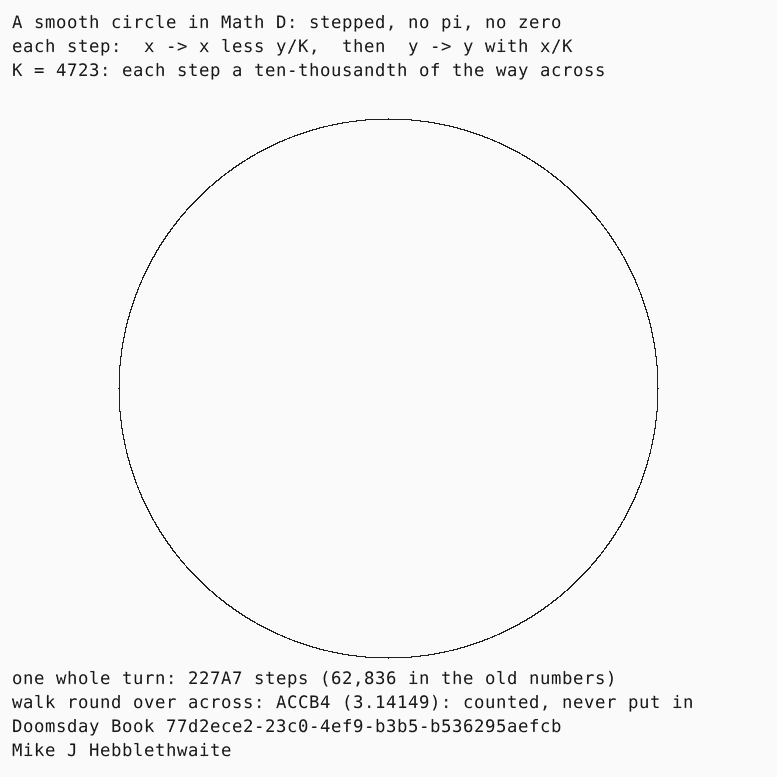
77d2ece2-23c0-4ef9-b3b5-b536295aefcb, Mike J HebblethwaiteIn the old maths
The old world calls the walk round over across π, 3.14159, and writes the rule as a turn by a small angle with cosine and sine. Here neither was put in: 3.14149 was counted, four steps short of the old figure in every hundred thousand. Archimedes, about 250 BC, boxed the circle between two 96-sided shapes by hand to pin π between 3.1408 and 3.1429; the counting here took two hundredths of a second.
Two circles, both counted
Free tiny steps, any way at all, give 3.1415 over across: what a tape round a wheel reads. Steps only along the hex, as atoms on a lattice take them one bond at a time, give the hex constant ⬡ (4 roots of 3, 6.93 times the radius). Mike: “a round thing in nature the real world is not pi it is hex”; “looks round and we make it look round”. Which walk nature’s rounds take at the atom is the question to test: a ring of atoms counted bond by bond.